Updated 09-January-2026
GCSE results day can feel like decoding a secret language. You’re handed numbers—9, 5, 4—and expected to know what they mean for your future. But what does each grade really represent? And does it work the same for everyone?
This guide cuts through the confusion, clearly explaining the 9–1 system, what constitutes a pass, and your exact next steps—whether you’re in school, home-educated, or a private candidate.
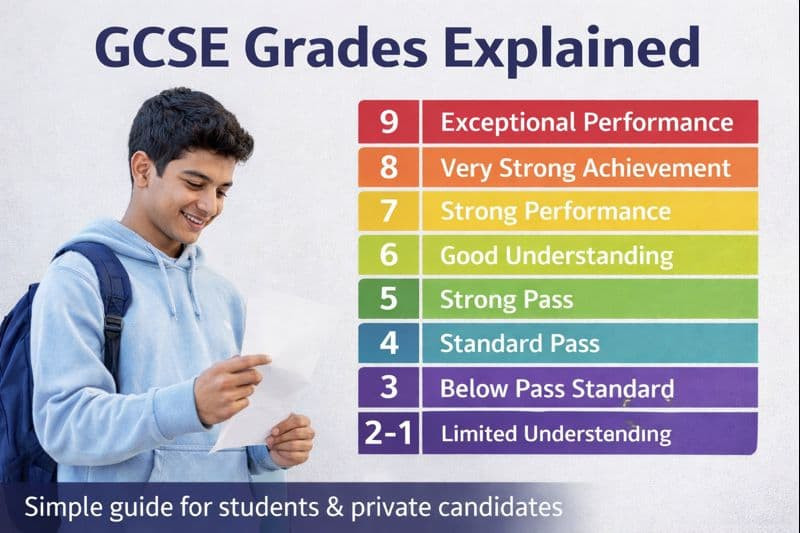
In England, GCSEs are graded from 9 to 1, replacing the old A*–G system. Every student—whether in school, privately tutored, or home-educated—is assessed against the same national standard.
Table: A visual guide to GCSE grade equivalents and their typical interpretation.
This causes the most confusion every results day:
Grade 4 = Standard Pass (the minimum level required by many institutions)
Grade 5 = Strong Pass (the government’s “good pass” benchmark)
Why this distinction matters:
While both are technically passes, selective sixth forms, colleges, and apprenticeship programmes increasingly require Grade 5 or above in core subjects like English and Maths.
Private candidates often worry their grades might be treated differently. They are not.
✔ Same exam papers
✔ Same anonymous marking
✔ Same grade boundaries
✔ Identical certificates
The only difference is administrative—how you enter for exams. Your grades carry exactly the same weight as those from school students.
Private Candidate Pro Tip:
When applying to colleges, briefly explain in your personal statement that you organised your GCSEs independently. This demonstrates initiative and self-discipline—qualities institutions value.
Met requirements: Celebrate and confirm your college or sixth-form place immediately.
Missed by one grade: Consider a priority review of marking (fast, paid service).
Note: grades can go down—seek advice before proceeding.
Missed by more: Move to Step 2.
November Resits (English & Maths only):
Quick turnaround
Keeps progression on track
Summer Resits (All subjects):
More preparation time
Can be combined with other studies
Resits are not failure. Many successful professionals improved key GCSEs later. Options include:
Alternative qualifications (e.g. Functional Skills for English/Maths)
Conditional progression (start Level 3 while resitting)
Specialist tuition before resitting
The Resit Roadmap: A clear visual guide to GCSE options after results day
❌ “Private candidates get lower grades”
✅ All scripts are marked anonymously. Examiners never know your background.
❌ “One bad grade ruins your future”
✅ Institutions focus on English, Maths, and relevant subjects. Other grades provide context.
❌ “Grade boundaries are set to fail people”
✅ Boundaries adjust yearly based on exam difficulty to maintain consistency.
Q: Is Grade 3 a complete fail?
A: It’s below the pass standard but shows foundational knowledge. English and Maths usually require resits, while progression in other areas may continue.
Q: Can I retake just one paper to improve?
A: No. You must retake all papers for that subject in the same series. Your highest overall grade counts.
Q: Do GCSE grades expire?
A: No. However, very competitive courses may prefer recent academic achievement.
Q: How many times can I resit?
A: As many as needed. Many students reach their target within 2–3 attempts with proper support.
GCSEs measure performance on a particular day—not your intelligence or potential. Pathways are flexible, resits demonstrate resilience, and understanding your grades is the first step toward your next achievement.
Whether you're celebrating top grades or planning resits, remember:
Pathways are flexible—education has more options than ever
Resits show resilience—a quality valued by employers
Understanding your grades is the first step toward your next achievement
Recent Posts
Categories
Tags